
 We’ve all watched it over our popcorn. The hero steps into a dimly lit room, scans the bookshelves, and plucks an ancient tome off the shelf. A cloud appears as the hero blows years of dust off before opening it to find what they need to solve the crisis.
It’s a great scene in a movie, but if the process of getting your crisis communications plan resembles this, there’s a problem. Fortunately, there’s a solution that will get both your communications plan and organization crisis ready.
Unlike our fictional hero, the more than 20 communications professionals who attended IABC/Calgary’s March 25 crisis communications workshop, From Plan to Exercise: Building a Crisis Resilience Program, were looking to move beyond the dusty bookshelf.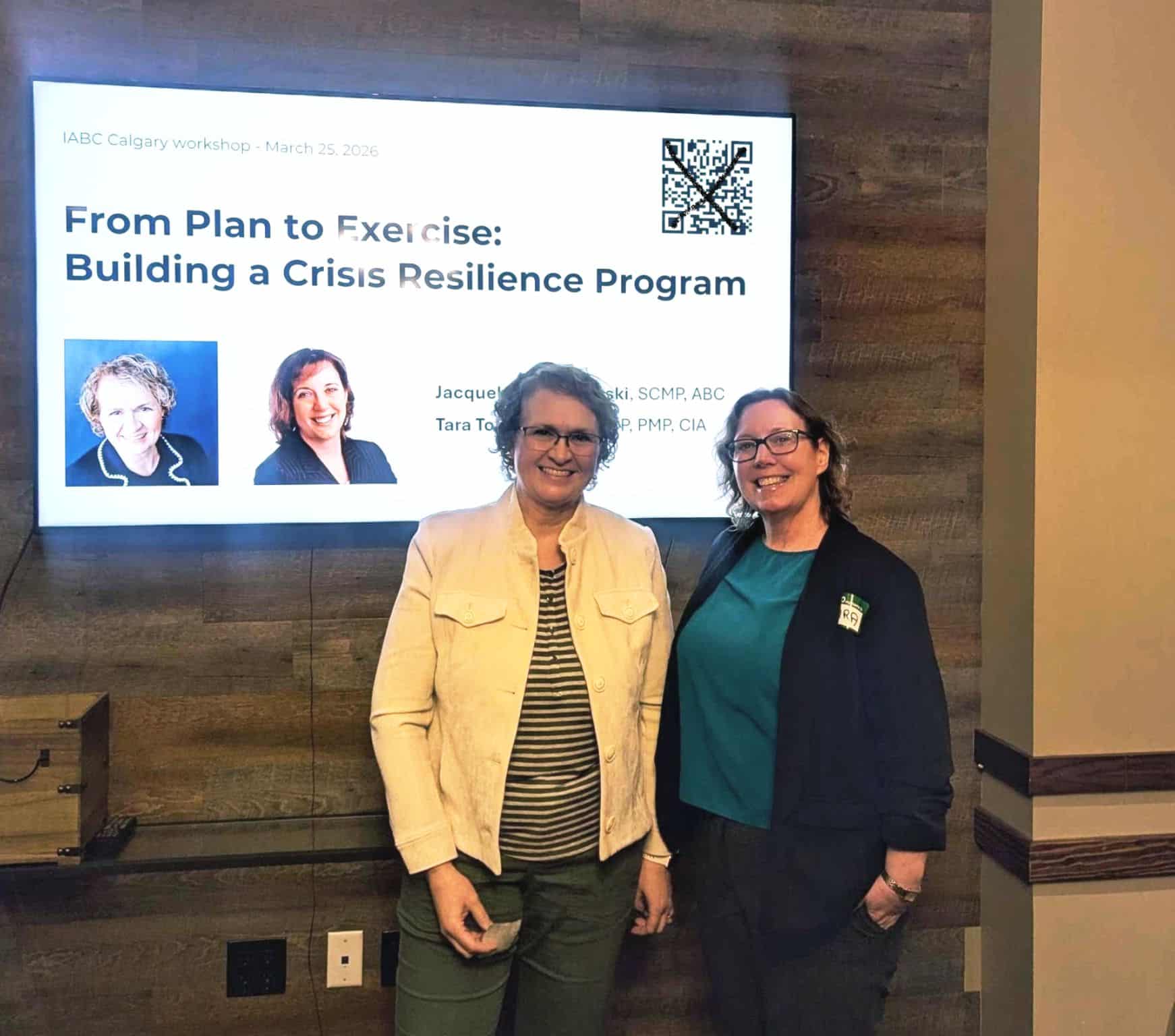
The workshop was co-hosted by IABC/Calgary member Jacquelynn Twarzynski, SCMP, ABC and Tara Tobler, MBA, CBCP, PMP, CIA. It focused on how to turn a static crisis communications plan into a dynamic program combined with a resilient organizational culture through regular planning, review and exercises.
“You don’t get fit by reading about exercise — it’s the same for crisis,” said Twarzynski.
The first step is to review your crisis communications plan, updating it as necessary and ensuring clarity in planning and messaging before the stress of a crisis takes over.
Key elements of crisis communications planning include clearly defining roles, both primary and their back-ups, and outlining the levels of crisis, the corresponding responses and the triggers to activate each level.
Clear messaging is another piece of the program to prepare in advance. As per Dr Vincent Covello’s proven template, develop three key messages each with three supporting facts. The first message needs to show compassion.
“Always start with compassion…show that you actually and legitimately care,” said Twarzynski.
Follow compassion with conviction.
“You may not have it fully under control, but you’re the one who is trustworthy, who is…working towards resolving it. And you’re the source of information that your audience can trust,” said Twarzynski.
The final message needs to show optimism and next steps.
“You always end with what’s next. Even if it’s a really difficult situation, we’re going to work through this as an organization,” she said.
To be ready for any situation, and to be able to respond if needed within the first so-called Golden Hour after a crisis hits, it’s also really useful to have pre-written and pre-approved holding statements ready for a range of potential situations. “This is how to establish your organization as the source of reputable information and updates, amongst all the noise that may come.”
An organization’s crisis response includes more than the communications plan. It requires entire departments, sometimes the entire organization, to pull together to implement a response to successfully navigate the crisis.
To return to the workout analogy, now that the plan is ready it’s time to start exercising.
“Don’t start super complex,” said Tobler, “start easy, build people’s comfort.”
Tobler recommends a progressive approach, going from plan walkthroughs to tabletop exercises and full simulations if necessary. This approach helps to identify gaps in the plan while building buy-in from staff and executives.
When planning an exercise, Tobler uses a five-step roadmap for success.
Set the Scope: Start by defining why you are running an exercise. Is it to train new staff, or incorporate learnings from a recent crisis event? Once the why is clear, set the scope, participants, and format.
Establish Objectives: This critical and often overlooked step defines what you are trying to achieve. What part of the plan are you exercising, who needs to be in the room as a participant and who needs to observe?
Build the Scenario: Develop a realistic scenario that aligns with the organization’s identified concerns and meets the established objectives for the exercise.
Conduct the Exercise: Prepare the logistics, confirming whether the exercise will be held in person or virtually. Set expectations before the exercise and then run the scenario. Ensure there is time to debrief in the room after the exercise. Tobler recommends cutting the exercise short if needed to ensure there is debrief time.
Review and Report: Record results and observations, define next steps, update the plan, and determine if additional training or exercises are needed.
Research has shown that eighty percent of crisis response can be anticipated and planned for in advance. By following this roadmap, crisis communicators and their organizations can develop robust plans with pre-approved holding statements, and role clarity that leaves the team crisis-ready with the agility needed to handle the 20 per cent of the unexpected when a crisis occurs.
Event Speaker Bios:
- Jacquelynn Twarzynski, SCMP, ABC
Jacquelynn helps organizations strengthen communications through strategic planning and practical problem-solving. She consults across public, private and nonprofit sectors, with expertise in issues management, crisis communications, audits and organizational change. A former IABC board member and chapter president, she is also a longtime mentor and awards judge.Tara Tobler, MBA, CBCP, PMP, CIA
Tara is a senior business continuity professional with more than 25 years of experience in crisis management, risk management and consulting across municipalities, healthcare, oil and gas and technology. She leads business continuity program development and assessments focused on fit-for-purpose solutions. Tara also instructs for the Disaster Recovery Institute and co-developed its exercise design curriculum.
Sources:
- From Plan to Exercise: Building a Crisis Resilience Program, IABC/Calgary workshop, March 26, 2026.
- Message Mapping, Dr. Vincent Covello, https://www.orau.gov/hsc/HealthCommWorks/MessageMappingGuide/02_GettingStarted.htm
https://centerforriskcommunication.org/
AI Assisted–Human Reviewed
AI was used to summarize event notes, presenter materials and other original source materials used by the human author as well as ideation and proofing before final publication review.
